
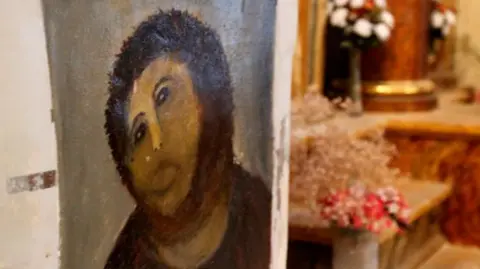
The elderly woman from Spain who made international headlines for her infamous repair job on a valuable Jesus Christ fresco has passed away at the age of 94.
Cecilia Giménez, a resident of the town of Borja in northern Spain, became a global sensation thirteen years ago after she attempted to restore a 100-year-old painting titled Ecce Homo located in her local church.
Giménez's handiwork spread across the internet and earned the moniker "Potato Jesus", because the resulting likeness of Christ's head looking somewhat like a furry primate.
Local Confirmation and Homage
The 94-year-old's death was announced by Borja's mayor, Eduardo Arilla, in a social media post, where he described her as a "great lover of painting from a young age".
"Descansa en paz Cecilia, your memory will live on with us," the mayor posted.
Arilla also paid tribute to Giménez's "now-legendary restoration of Ecce Homo" in the summer of 2012, which "due to the poor state of conservation it was in, Cecilia, acting in good faith, decided to repaint the work over".
The Artwork's History and the Now-Infamous Intervention
The Ecce Homo ("This is the Man" in Latin) by nineteenth-century painter Elias Garcia Martinez had been held for over a hundred years in the Santuario de la Misericordia close to Zaragoza.
In 2012, Giménez, who was 81 years old, explained that parishioners had "always repaired everything here", and that she had received permission from the parish priest to do the work.
She added at the time that anyone who came into the church would have observed she was painting over the existing image.
An Unexpected Economic Lifeline
The impact of the restoration spawned the "Monkey Christ" internet phenomenon and saw the once quiet town of Borja rapidly turn into a significant visitor attraction.
The town, which had previously welcomed just 5,000 visitors per year, attracted more than 40,000 tourists by 2013, and generated more than €50,000 for charity from the attention.
Currently, officials say that between 15,000 and 20,000 tourists visit Borja each year to view the notorious portrait, which is now displayed behind a protective shield of glass.
Later Life and Local Support
Following the initial backlash, backed by local residents and well-wishers around the world, Giménez went on to hold an art exhibition featuring twenty-eight of her own works.
She was praised by the mayor for her generosity and years of dedication to the parish.
In the end, what began as a sincere but unsuccessful act of restoration forged an unlikely piece of pop culture and provided unprecedented attention and resources to a humble Spanish town.
